If you are trying to buy a manufactured home and you do not have perfect credit or a large down payment, an FHA loan for a manufactured home may be one of your best options. The Federal Housing Administration (FHA) offers two distinct loan programs specifically for manufactured homes, and understanding how they work can save you thousands of dollars and a lot of frustration.
This guide explains both FHA manufactured home loan programs clearly, including who qualifies, what the requirements are, how much you can borrow, and what the process looks like from application to closing.
What Is an FHA Loan?
FHA loans are mortgages insured by the Federal Housing Administration, which is part of the U.S. Department of Housing and Urban Development (HUD). Because the FHA insures the loan, lenders take on less risk — which allows them to offer loans to borrowers with lower credit scores and smaller down payments than conventional lenders typically require.
FHA loans are not made directly by the government. You apply through an approved private lender, and the FHA guarantees that loan against default.
FHA Title I vs. FHA Title II: What Is the Difference?
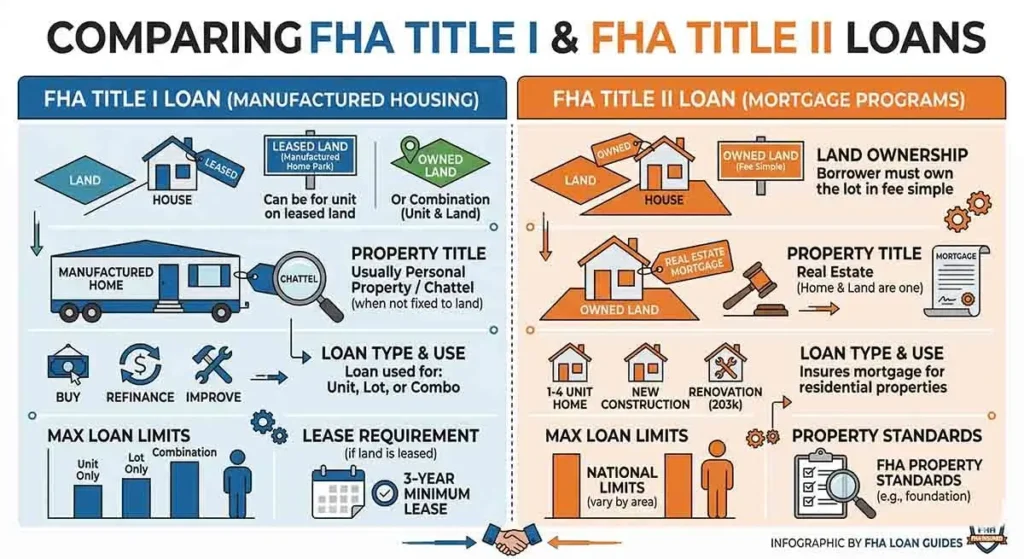
For manufactured homes, the FHA offers two separate loan programs. Which one you qualify for depends primarily on whether you own the land your home sits on.
FHA Title I Loans
FHA Title I loans are designed for manufactured homes on leased land or in a mobile home park. These are personal property loans insured by the FHA.
- Maximum loan amount for a manufactured home only: $69,678
- Maximum loan amount for a home plus lot: $92,904
- Maximum loan term for a home only: 20 years
- Maximum loan term for a home and lot: 25 years
- The home does not need to be on a permanent foundation
FHA Title II Loans
FHA Title II loans treat manufactured homes more like site-built homes. These are real property loans — actual mortgages — which means the home must be permanently affixed to land that the borrower owns or is purchasing.
- The home must be on a permanent foundation
- The home must be classified as real property
- The borrower must own or be purchasing the land
- Loan limits follow standard FHA conforming limits
- Down payment as low as 3.5% with a 580+ credit score
FHA Manufactured Home Requirements
HUD Code Compliance
The home must have been built on or after June 15, 1976, the date the HUD Manufactured Home Construction and Safety Standards went into effect. Every compliant home must have a red certification label (HUD tag) attached to each section. If these tags are missing, you will need to get verification from the Institute for Building Technology and Safety (IBTS).
Minimum Size Requirements
The home must be at least 400 square feet for a single-section home and must meet HUD habitability standards.
Permanent Foundation (Title II)
For Title II loans, the home must be on a permanent foundation that meets HUD’s Permanent Foundations Guide for Manufactured Housing. This typically means a continuous concrete perimeter foundation or concrete piers.
No Wheels, Axles, or Hitch
For Title II, the manufactured home must have had its transportation undercarriage removed by closing.
Credit Score and Down Payment Requirements
- Credit score 580+: Minimum 3.5% down payment
- Credit score 500 to 579: Minimum 10% down payment
- Credit score below 500: Not eligible for FHA financing
Keep in mind that individual lenders may have stricter requirements than the FHA minimum. Many FHA-approved lenders require a minimum 620 credit score. Shopping multiple lenders is important to find one whose requirements match your credit profile.
FHA Mortgage Insurance Premiums (MIP)
FHA loans require two types of mortgage insurance:
- Upfront MIP: 1.75% of the loan amount, paid at closing (rolled into the loan)
- Annual MIP: 0.55% to 1.05% of the loan balance, paid monthly
Unlike conventional loans where PMI removed at 20% equity, FHA MIP on loans originated after June 2013 remains for the life of the loan if your down payment was less than 10%. Factor this into your total monthly payment calculation.
Finding FHA-Approved Lenders for Manufactured Homes
Not all FHA-approved lenders offer manufactured home loans. Specialty lenders like 21st Mortgage Corporation and Vanderbilt Mortgage are among the most experienced in this space. Some regional banks and credit unions in manufactured-home-heavy states like Texas, Florida, and the Carolinas also have strong manufactured home lending programs.
Use the HUD lender search tool at hud.gov to find FHA-approved lenders in your area, and always compare at least three lenders before choosing one.
The Application Process
- Check your credit score and resolve any errors on your credit report
- Gather financial documents: two years of tax returns, recent pay stubs, bank statements
- Get pre-approved by an FHA-approved lender who works with manufactured homes
- Find your home and have it appraised by an FHA-approved appraiser
- Complete underwriting and satisfy any conditions
- Close on the loan
The process typically takes 30 to 60 days from application to closing.
Is an FHA Loan the Right Choice for You?
FHA loans make the most sense for manufactured home buyers who have limited cash for a down payment, credit scores in the 580 to 660 range, or both. If you have strong credit (700+) and a 10 to 20 percent down payment, you may find that conventional financing or a VA or USDA loan offers better terms.
The key is to compare all your options before committing. FHA loans are a powerful tool for making manufactured homeownership accessible, but they are not automatically the cheapest option for every borrower.
The Bottom Line
FHA loans for manufactured homes — both Title I and Title II — give millions of Americans access to financing that they might not otherwise qualify for. Understanding the difference between the two programs, knowing the requirements, and shopping multiple FHA-approved lenders are the keys to getting the best possible deal.

Marcus T. Webb is a former bank loan officer with 14 years in manufactured home lending. He has originated FHA, VA, USDA, and chattel loans across North Carolina and Tennessee. Today he writes about manufactured home finance to help buyers avoid the costly mistakes he watched happen in banks for over a decade.