Selling a manufactured home involves more steps than selling a traditional site-built house — and getting those steps wrong can delay your sale for months or expose you to legal liability. Whether your home is on leased land in a park or on land you own, understanding how to sell a manufactured home correctly is the key to a smooth, successful transaction.
This guide covers the complete legal process, pricing strategy, finding buyers, and everything else you need to know to sell your manufactured home in 2026.
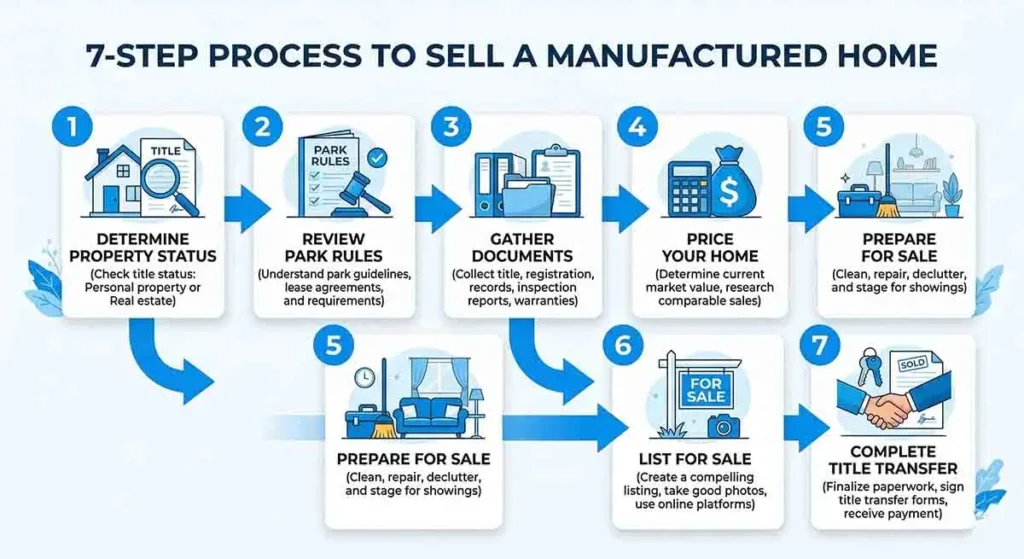
Step 1: Determine Your Home’s Legal Status
Before doing anything else, you need to know whether your manufactured home is personal property or real property — because this determines the entire sale process.
Personal Property (Chattel Title)
If your home is in a mobile home park on leased land, or on land that you do not own, it is almost certainly personal property with a certificate of title issued by your state’s DMV or motor vehicle equivalent — similar to a car title. Selling personal property manufactured homes involves transferring this certificate of title, not a deed.
Real Property (Real Estate Deed)
If your home is on land you own, permanently affixed to a foundation, and has gone through the title conversion process, it is real property recorded with your county’s land records as a deed. Selling a real property manufactured home involves a traditional real estate transaction with a deed transfer — just like selling a site-built home.
If you are not sure which category your home falls into, check whether you have a certificate of title from the DMV (personal property) or a deed from the county recorder (real property). The distinction dictates which sale process you will follow.
Step 2: Know Your Park Rules (For Park-Based Homes)
If your home is in a mobile home park, review your lease and the park’s rules regarding sales before proceeding. Most parks have provisions that:
- Require you to notify management before selling
- Give the park the right to approve incoming residents (the buyer must qualify to live in the park)
- Prohibit the park from unreasonably blocking a legitimate sale
- Address what happens to lot rent between the sale agreement and closing
In most states, the park cannot prevent you from selling your home, but they can require buyers to apply for tenancy and can reject applicants who do not meet reasonable screening criteria. Understanding these rules before listing your home prevents surprises during the sale process.
Step 3: Gather Your Documents
Having your paperwork in order before listing speeds up the sale significantly. Gather:
- Certificate of title (for personal property) or deed (for real property) — you cannot transfer ownership without the original title or deed
- HUD certification labels documentation — if the red tags are missing, contact IBTS (ibts.org) for label verification
- Payoff statement from your lender — if you have an outstanding chattel loan or mortgage, get a written payoff statement showing the exact amount needed to release the lien
- Any warranties or manuals for appliances or systems
- Previous inspection reports if available
- Recent utility bills — buyers often ask about average utility costs
- Lease agreement (for park homes) — buyers and their lenders will want to review it
Step 4: Price Your Home Correctly
Overpricing is the most common mistake manufactured home sellers make. Unlike site-built homes, manufactured homes have less standardized comparable sale data, and online automated valuation tools like Zillow’s Zestimate are notoriously unreliable for manufactured homes.
How to Price a Manufactured Home Accurately
For real property homes: Have a licensed real estate appraiser who specializes in manufactured homes conduct a formal appraisal. This typically costs $300 to $600 and gives you a defensible market value for pricing and for your buyer’s financing. You can also research recent sale prices of comparable manufactured homes on land in your area through your county assessor’s records or a local real estate agent.
For personal property homes: Research recent sales on MHVillage.com, Zillow, and local Craigslist listings for comparable homes in your park or nearby parks. Consider lot rent as a significant factor — buyers will calculate their total monthly cost (purchase payment plus lot rent) when evaluating affordability.
Be realistic about the impact of home age, condition, and park rent levels on value. A 20-year-old home in a park with $800 monthly lot rent may be difficult to sell above $30,000 to $40,000 regardless of its cosmetic condition.
Step 5: Prepare Your Home for Sale
First impressions matter enormously in manufactured home sales. Invest in these preparation steps before listing:
- Deep clean the entire home — inside, outside, and under (check skirting)
- Repair obvious defects — fix any soft floor spots, patch drywall holes, repair broken fixtures, replace burnt-out bulbs
- Freshen paint — a fresh coat of neutral interior paint is one of the highest-ROI sale preparation investments
- Address curb appeal — clean up landscaping, repair skirting, clean or paint the exterior if needed
- Declutter and depersonalize — buyers need to visualize themselves in the space, not navigate around your belongings
Step 6: List Your Home for Sale
For Sale By Owner (FSBO)
If you want to sell without an agent, list on MHVillage.com (the largest dedicated manufactured home marketplace), Zillow (as FSBO), Facebook Marketplace, and Craigslist. Take high-quality photos in good lighting and write a detailed description highlighting the home’s best features and key specifications.
Real Estate Agent (For Real Property Homes)
If your manufactured home is real property, you can list it on the MLS through a licensed real estate agent just like a site-built home. An agent with manufactured home experience can help you price correctly, market effectively, and navigate the transaction. Agent commissions typically run 5 to 6 percent of the sale price.
Manufactured Home Dealers (Trade-In or Consignment)
Some manufactured home dealers will accept used homes on trade or sell them on consignment. This is less common but may be an option if you are purchasing a new manufactured home from a dealer.
Step 7: The Title Transfer Process
Personal Property Title Transfer
To transfer a personal property manufactured home title:
- Obtain a payoff statement from your lender and ensure the lien will be released at closing
- Sign the back of the original certificate of title (seller section)
- Buyer pays and signs the buyer section
- Both parties submit the completed title to the state DMV or manufactured housing agency to issue a new title in the buyer’s name
- The buyer pays any applicable transfer fees and taxes
Real Property Deed Transfer
Real property manufactured home sales follow the same process as site-built home sales — a deed is prepared (typically by a title company or attorney), signed, notarized, and recorded with the county recorder. A title company typically manages this process and issues title insurance to the buyer and their lender.
Taxes on the Sale
Depending on your state and the nature of the sale, you may owe taxes:
- Federal capital gains tax: If you have lived in the home as your primary residence for at least 2 of the last 5 years, you may exclude up to $250,000 of gain ($500,000 for married couples) from federal capital gains tax
- State transfer taxes: Many states charge a transfer tax or documentary stamp tax on real property sales
- Personal property transfer fees: State DMVs typically charge fees for manufactured home title transfers
Consult a tax professional about the specific tax implications of your manufactured home sale.
The Bottom Line
Selling a manufactured home correctly requires understanding whether your home is personal or real property, having your title documentation in order, pricing the home accurately based on real market data, and following the correct transfer process for your home’s legal status.
Taking the time to prepare the home properly, gather all documents, and price it correctly at the outset will result in a faster sale at a better price — and far fewer headaches during the transaction.

Darnell J. Okafor is a former housing attorney and legal aid lawyer who spent nine years representing manufactured home residents in Texas. He writes about tenant rights, eviction law, title issues, and legal protections for OwnedNotOwned.com — bringing attorney-level knowledge to readers who need clear answers.