Living in a mobile home park means living under a set of rules — but not every rule a park management posts or enforces is actually legal. Many manufactured home park residents do not realize that park rules have legal limits, and that park management sometimes oversteps those limits in ways that violate state law.
This guide explains what mobile home park rules can and cannot legally cover, how rules must be communicated to be enforceable, and what you can do when a park enforces rules that cross the legal line.
Where Do Mobile Home Park Rules Come From?
Mobile home park rules exist in two forms:
The lease agreement: This is the primary legal document governing your relationship with the park. It specifies your lot rent amount, when and how rent can be raised, notice requirements, and the terms under which you can be evicted. The lease is a contract, and both parties — you and the park — are bound by its terms.
Park rules and regulations: These are typically a separate document — sometimes called community guidelines, house rules, or park regulations — that cover day-to-day conduct standards: pet policies, parking rules, speed limits, quiet hours, guest policies, and similar matters. In most states, rules and regulations must be provided to residents at lease signing, and any changes to them require advance written notice.
What Mobile Home Parks CAN Legally Regulate
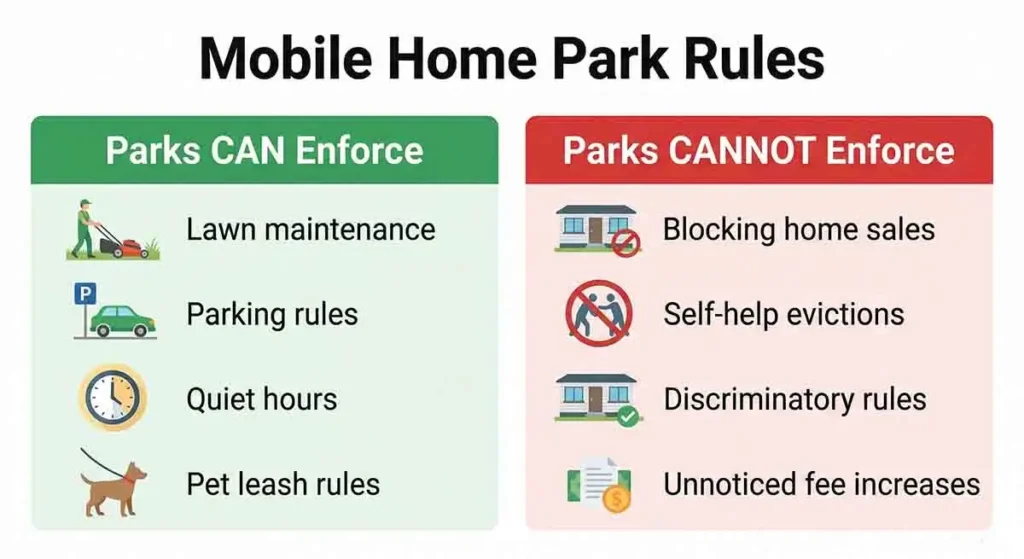
Within legal limits, mobile home parks have broad authority to set reasonable rules governing their communities. Courts have generally upheld parks’ rights to regulate:
Lot Appearance and Maintenance
Parks can require residents to maintain the exterior of their home and lot in a neat, clean condition. This typically includes:
- Keeping the lawn mowed and landscaping maintained
- Removing accumulated junk, debris, or trash from the lot
- Maintaining the exterior of the home in reasonable condition (no peeling paint, broken skirting, etc.)
- Keeping skirting in good repair and installed properly
Parking Rules
Parks can limit the number of vehicles per lot, designate parking areas, prohibit commercial vehicles or RVs from being stored on lots, and set speed limits for park roads. These rules are generally upheld as reasonable traffic and safety management.
Pet Policies
Parks can restrict pets — limiting the number of pets per lot, requiring pets to be leashed in common areas, specifying weight or breed restrictions. However, the federal Fair Housing Act and most state fair housing laws require parks to make reasonable accommodations for residents with documented disabilities who require service animals or emotional support animals — parks cannot refuse these animals even if they have a no-pet policy.
Quiet Hours
Parks can establish and enforce quiet hours — typically 10 PM to 8 AM — to protect the peaceful enjoyment of all residents. Enforcement of quiet hours through warnings and ultimately through lease termination for repeated violations is generally legal.
Guest Policies
Parks can regulate guests — limiting the length of guest stays and requiring that guests not park in restricted areas. Most states, however, limit parks’ ability to charge fees for guests or to prohibit overnight guests entirely, as this can cross into controlling residents’ personal lives in ways courts have not upheld.
Business Use of Lots
Parks can prohibit residents from operating commercial businesses from their homes or lots, including parking commercial vehicles, conducting customer traffic, or operating home-based businesses that create excessive noise or traffic.
What Mobile Home Parks CANNOT Legally Do
Park management authority has real limits. Here are the areas where parks most commonly overreach:
Cannot Evict Without Legal Cause and Proper Process
In virtually every state, a park cannot evict a resident without a legally recognized cause — typically non-payment of rent, violation of park rules (after proper notice and opportunity to cure), or the park going out of business. And even for-cause evictions must follow a specific legal process: written notice, opportunity to cure the violation, and formal court proceedings if the resident does not vacate voluntarily.
Self-help evictions — removing someone’s home, disconnecting their utilities, or physically removing the resident without going through the court process — are illegal in every state and can expose the park to significant liability.
Cannot Prevent Home Sales
Most states explicitly prohibit parks from preventing residents from selling their manufactured homes. The park typically has the right to approve incoming residents (within fair housing law limits), but it cannot use that approval process to block a legitimate sale or to require the resident to sell the home to the park at a below-market price.
Cannot Discriminate Under Fair Housing Law
The federal Fair Housing Act prohibits discrimination in the sale or rental of housing based on race, color, national origin, religion, sex, familial status (families with children), and disability. Mobile home parks are covered by the FHA. Refusing to rent to a family because they have children, or applying rules more strictly to residents of a particular race or national origin, is illegal.
Cannot Charge Fees Not in the Lease
Parks cannot impose fees — for guests, pets, parking, entry — that are not disclosed in the original lease or added through a properly noticed lease amendment. Surprise fees or charges that appear without proper notice are generally unenforceable.
Cannot Retroactively Apply New Rules
If you have a pet that was allowed when you moved in and the park later adopts a no-pet policy, in most states the park cannot retroactively apply that rule to your existing pet. Grandfathering of existing situations is generally required when parks adopt new restrictive rules.
Cannot Raise Rent Without Proper Notice
As discussed in our lot rent article, parks must provide proper advance notice before raising lot rent — typically 30 to 90 days depending on state law. They also cannot raise rent in retaliation for a resident exercising their legal rights (such as complaining about habitability conditions to a housing authority).
How Rules Must Be Communicated to Be Enforceable
For park rules to be legally enforceable, they must generally:
- Be in writing and provided to the resident at or before lease signing
- Be applied consistently to all residents (selective enforcement raises discrimination concerns)
- Be reasonable in scope — courts will not enforce arbitrary or unreasonably burdensome rules
- Changes to existing rules must be communicated in advance with sufficient notice
If a park is trying to enforce a rule against you that was never communicated in writing, or that is being applied only to you and not to other residents, these are significant legal vulnerabilities in the park’s position.
What to Do When You Believe a Rule Is Being Illegally Enforced
- Document everything: Keep written records of every interaction with park management, all notices received, and all relevant dates. Take photographs of your lot and home regularly.
- Review your lease and state law: Compare the rule being enforced against your lease terms and your state’s manufactured home resident protection statutes.
- Respond in writing: If you receive a notice of alleged rule violation, respond in writing — never just verbally. State your position clearly and keep a copy.
- Contact your state’s manufactured housing authority: Most states have an agency that oversees manufactured home park regulation. File a complaint if you believe a park is acting illegally.
- Consult a tenant rights attorney: Many states have legal aid organizations that provide free or low-cost assistance to manufactured home park residents facing illegal enforcement.
- Connect with other residents: If others in the park are experiencing the same issue, a collective response is far more powerful than an individual one.
The Bottom Line
Mobile home parks have legitimate authority to set reasonable rules that protect the community’s safety, appearance, and peaceful enjoyment. But that authority has legal limits — limits defined by your lease, your state’s manufactured housing statutes, and federal fair housing law.
Know your rights before a problem arises. Read your lease, research your state’s tenant protection laws, and do not assume that everything a park management says or posts is legally enforceable. In many cases, it is not.

Darnell J. Okafor is a former housing attorney and legal aid lawyer who spent nine years representing manufactured home residents in Texas. He writes about tenant rights, eviction law, title issues, and legal protections for OwnedNotOwned.com — bringing attorney-level knowledge to readers who need clear answers.