One of the most common questions from people considering a manufactured home is: can you put a manufactured home on any land? The simple answer is no — and understanding why is critical before you spend money on land or a home.
Multiple layers of rules govern where manufactured homes can legally be placed: federal standards, state laws, county zoning ordinances, deed restrictions, and practical requirements like soil conditions and utilities. This guide walks through all of them.
The Short Answer: What Determines Where You Can Place a Manufactured Home
Whether you can place a manufactured home on a specific piece of land depends on five main factors:
- Local zoning laws
- Deed restrictions and HOA rules
- State-level regulations
- Physical characteristics of the land (soil, slope, flood zone)
- Utility availability (water, sewer or septic, electricity)
All five must be favorable for a placed manufactured home to be legal and livable. Missing even one can stop your project entirely.
Factor 1: Zoning Laws — The Most Important Barrier
Zoning is the most significant legal barrier to placing a manufactured home on land. Zoning is regulated at the local level — typically by counties in rural areas and by cities or municipalities in urban areas. And Zoning laws divide land into districts (residential, commercial, agricultural, industrial) and specify what types of structures can be built or placed in each district.
Where Manufactured Homes Are Generally Allowed
Agricultural zones (A-1, A-2, etc.): Most agricultural zones allow manufactured homes as primary residences on the property. This is one reason rural land is often attractive to manufactured home buyers — fewer zoning restrictions.
Single-family residential zones that allow manufactured homes: Many residential zones explicitly allow manufactured homes, though some require the home to meet certain aesthetic standards (minimum size, specific exterior finishes, pitched roof requirements, etc.).
Manufactured home districts: Some areas have specific zoning districts created for manufactured housing, where manufactured homes are the primary or exclusive type of housing allowed.
Where Manufactured Homes Are Often NOT Allowed
Exclusive single-family residential zones: Some residential zones explicitly exclude manufactured homes, allowing only site-built construction. This is more common in suburban areas and in states without strong manufactured housing protection laws.
Commercial and industrial zones: Residential use including manufactured homes is generally prohibited in commercial and industrial zones.
Historic districts: Properties in designated historic districts typically have strict architectural controls that make placed manufactured homes impossible.
How to Find Your Zoning Classification
Before purchasing land for a manufactured home, contact your local county or city planning and zoning department and ask specifically: “Is this parcel zoned to allow placement of a HUD-code manufactured home as a primary residence?” Get the answer in writing. Do not assume — zoning rules vary enormously even within a single county.
Factor 2: State-Level Protections (or Lack Thereof)
Federal law (the National Manufactured Housing Construction and Safety Standards Act) contains a provision that prohibits local governments from completely excluding manufactured homes from residential areas if site-built homes are permitted. However, this federal protection has limits and enforcement is inconsistent.
Several states have enacted their own stronger manufactured housing protection laws:
- North Carolina: Has one of the stronger state protections, requiring that manufactured homes meeting HUD standards be allowed anywhere single-family site-built homes are permitted
- Texas: Has strong protections for manufactured home placement on private land
- Minnesota, Oregon, New Hampshire: Have various state-level protections limiting local restrictions on manufactured housing
Other states have weaker protections, giving localities more power to restrict or exclude manufactured homes. If you are in a state with weaker protections, local zoning restrictions carry more weight.
Factor 3: Deed Restrictions and HOA Rules
Even if the zoning allows manufactured homes, deed restrictions or homeowners association (HOA) rules may prohibit them. Deed restrictions are private covenants recorded in the property’s deed that run with the land — they bind current and future owners regardless of zoning.
Common deed restrictions that affect manufactured home placement:
- “No manufactured or mobile homes” — explicitly prohibits placement
- Minimum square footage requirements that a manufactured home may or may not meet
- Minimum construction standards (site-built only, specific foundation requirements)
- Architectural approval requirements that may exclude manufactured homes
Always request a full title search and review all deed restrictions before purchasing land for a manufactured home. Deed restrictions are enforceable by neighboring property owners and HOAs even if the local government would not otherwise object.
Factor 4: Physical Land Requirements
Beyond legal issues, the physical characteristics of the land must be suitable for manufactured home placement.
Soil Conditions and Foundation Requirements
The land must be able to support the foundation required for a manufactured home. Some soils — expansive clay soils, saturated soils, areas with high organic content — may require special foundation engineering to support a manufactured home safely. In some extreme cases, the cost of a special foundation may make a site impractical.
A soil boring or percolation test can reveal soil conditions before you commit to purchasing land.
Slope and Grading
Manufactured homes require reasonably level ground. Significant slopes require grading — cutting into the hillside and filling lower areas to create a level pad. Grading costs vary enormously depending on the amount of material to be moved, but can easily run $5,000 to $25,000 or more on a challenging site.
Flood Zone Status
Properties in FEMA-designated flood zones face special challenges for manufactured home placement. In some flood zones, manufactured homes are completely prohibited. In others, they are allowed but must be elevated above the base flood elevation — often requiring a very expensive elevated foundation system.
Check the FEMA Flood Map Service Center (msc.fema.gov) to look up any property’s flood zone designation before purchasing. If the property is in Zone AE or V, get a detailed cost estimate for flood-compliant manufactured home installation before committing.
Factor 5: Utility Availability
A manufactured home requires connections to water, wastewater disposal, and electricity to be livable. The availability of these utilities is a critical practical consideration for rural land purchases.
Water
Urban and suburban land typically has municipal water service available. Rural land often does not, requiring a private well. A well drilling permit and the actual well drilling cost $3,000 to $15,000 depending on depth and local conditions.
Wastewater
If public sewer is not available, the land must be able to support a septic system. Before purchasing rural land, have a percolation test (perc test) performed — this determines whether the soil can absorb septic system effluent at the rate required for your home size. Not all land passes a perc test, and land that fails cannot have a conventional septic system installed.
Alternative septic systems (mound systems, aerobic treatment units) can be installed on land that fails a conventional perc test, but they cost significantly more — sometimes $15,000 to $30,000 versus $5,000 to $10,000 for a conventional system.
Electricity
Electric service is almost always available, but in very rural areas, the cost to extend power lines to a remote property can be substantial — sometimes $5,000 to $30,000 or more per mile of line extension. Always get a quote from your local utility before purchasing remote land.
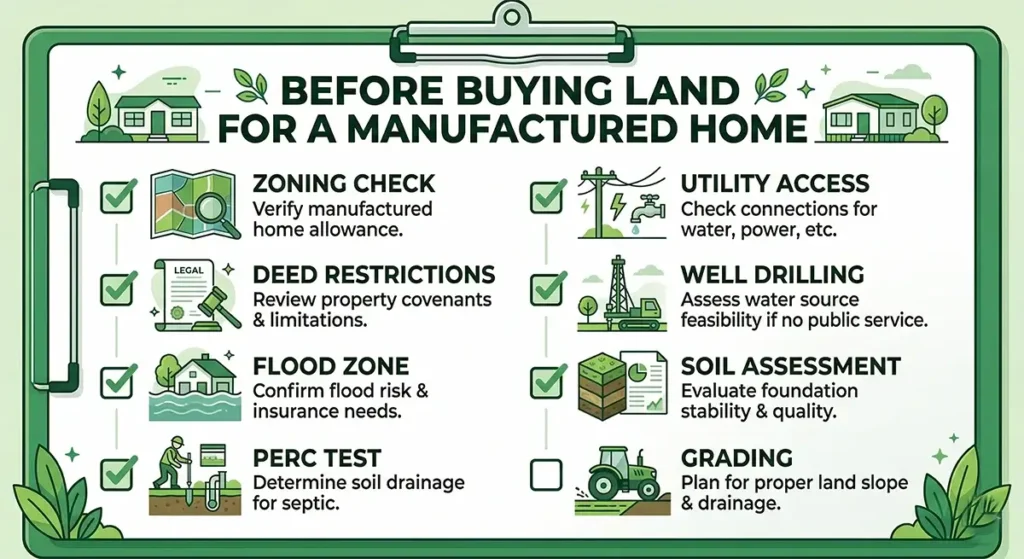
Practical Checklist Before Buying Land for a Manufactured Home
- Contact the county planning and zoning department — confirm manufactured homes are allowed
- Review all deed restrictions and CC&Rs for the property
- Check flood zone status at msc.fema.gov
- Arrange a percolation test (for rural land without public sewer)
- Get a utility extension cost estimate from the local electric company
- Get quotes for well drilling if municipal water is not available
- Have a soil assessment done if you have any concerns about the terrain
- Budget for grading if the site is not level
The Bottom Line
You cannot put a manufactured home on just any land. Zoning laws, deed restrictions, flood zone status, soil conditions, and utility availability all play a role in determining whether a specific parcel is a viable manufactured home site.
The good news is that if you do your homework before purchasing — checking zoning, reviewing deed restrictions, confirming utility access, and assessing physical site conditions — you can avoid the costly mistake of buying land that does not work for your plans.

Beth Anne Calloway is a rural development specialist turned writer with 15 years of experience helping families navigate land use, USDA programs, rural zoning, and manufactured home placement on private land. She and her husband live on 12 acres in East Tennessee in a manufactured home they placed themselves — and she learned every lesson the hard way so you do not have to.